Last updated 2026-08-19
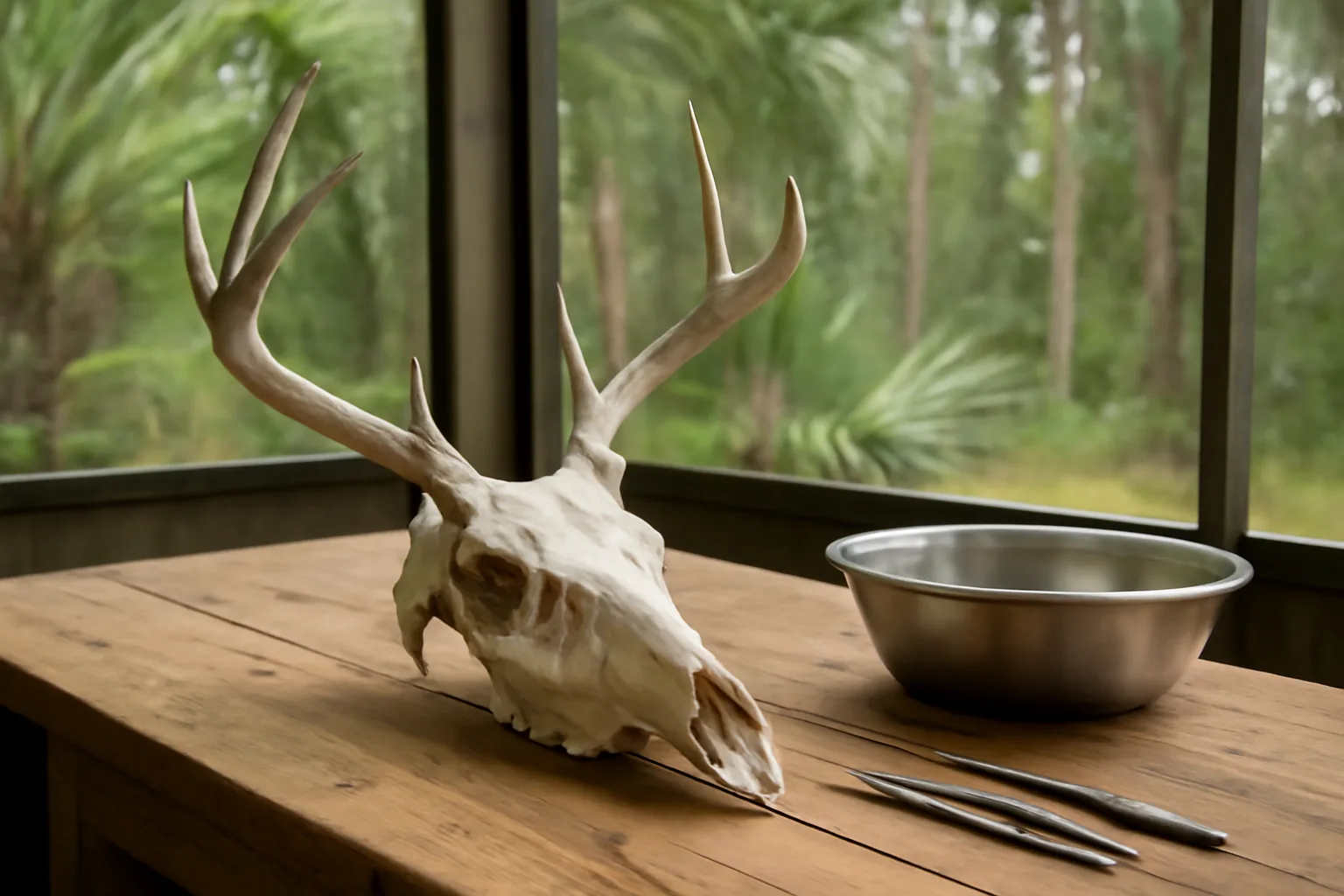
TL;DR
European mount renewal in Florida is the yearly license and business-filing cycle for a skull shop, not a redo of the mount. Confirm any FWC taxidermy credential and fee with FWC. Add a USFWS permit if you mount migratory birds for others. File the Sunbiz annual report between January 1 and May 1. State sales tax is 6 percent. Shop prices and turnaround are not set by Florida.
What does european mount renewal in Florida actually mean?
European mount renewal in Florida means keeping the shop's legal paper current. It is not a second whitening of the same deer. You renew the FWC credential if your work needs one, you keep any USFWS bird permit alive, and you file the ordinary annual business reports. The skull is the product. Renewal is the file cabinet.
Plenty of new operators mix those two jobs. They argue about peroxide while an expired county receipt sits in a drawer. Or they think a hunting license covers paid customer work. It does not.
Florida does not sell a permit literally named european mount florida. Skull work sits under taxidermy practice, wildlife possession rules, and regular business law. FWC is the wildlife board. The Department of State runs Sunbiz. Counties levy a local business tax. The Department of Revenue handles sales tax. [1][7][8][11]
I'd treat renewal as a calendar. Put the Sunbiz window (January 1 to May 1) next to your county's business tax month. Read the expiration printed on any FWC paper you hold. I will not invent a current fee or a processing time. Those belong to the board that issued the document.
If hunters also bring you work from next door, do not assume Florida paper travels. european mount renewal in georgia and european mount renewal in alabama are separate files.
Do you need a license for european mount in Florida?
Yes, plan on state wildlife paper if you mount birds or animals for other people in Florida, and confirm the exact FWC class and fee with FWC before you take a customer skull. A hunting license is not a taxidermy license. Migratory birds add a federal permit. Ordinary business tax and sales tax still apply even if the wildlife piece looks small.
Dead, legally taken game is not the same legal object as a live bobcat in a cage. The captive wildlife statutes still matter because FWC wrote taxidermy operations into the wildlife code. Fla. Stat. 379.3761 says, except as provided in subsection (6), "a person may not keep, possess, import into the state, sell, barter, trade, or breed any wildlife until she or he obtains a permit or license authorizing her or him to engage in such activity from the Fish and Wildlife Conservation Commission." [1]
That sentence is broad. How FWC applies it to a freezer full of deer heads is a classification question. You do not settle it on a forum. You settle it with the agency that can fine you. Current classes and applications sit on FWC's captive wildlife license pages. Read those, then call if the chart is fuzzy. [2]
Florida Administrative Code 68A-12.004 is the rule people actually mean when they talk about taxidermy operations and possession of birds or mammals. Read the current text on flrules.org before you open. Rules get amended. [2]
I would not open a customer-facing european mount bench on a verbal claim that "FWC doesn't care about deer skulls." If the work is only your own legally taken deer, the answer can be narrower. The minute money changes hands, act like you need the credential and then confirm.
The federal overlay is cleaner. If you perform taxidermy on migratory birds for anyone other than yourself, you need a U.S. Fish and Wildlife Service taxidermist permit. Deer and wild turkey are not migratory birds under that statute. Ducks, geese, and doves are. Alligator work in Florida is its own FWC world. Do not assume a deer-skull habit covers a gator skull. [3][4]
Business paper is not optional because wildlife paper exists. Counties may levy a local business tax under F.S. 205.032. If you operate under a name that is not your personal legal name, Florida's fictitious name statute applies. [8][9]
Confirm current FWC fees and forms with FWC. I am not going to invent a dollar figure or a turnaround. Invented fees are how people mail the wrong check.
What paper do you renew each year for a Florida skull shop?
You renew every credential that has an expiration date, and you file the annual reports that do not care whether you mounted ten skulls or two hundred. In practice that is FWC if you hold a taxidermy or wildlife license, USFWS if you hold a migratory bird taxidermist permit, the Sunbiz annual report for an LLC or corporation, the county local business tax receipt, and your sales tax filings with the Department of Revenue.
| Paper | Who issues it | What you confirm |
|---|---|---|
| FWC taxidermy or wildlife credential | FWC | Class, fee, expiration |
| USFWS taxidermist permit | USFWS | Needed for migratory bird work for others |
| Sunbiz annual report | Florida Department of State | File January 1 to May 1 |
| Local business tax | County or city | Rate and month |
| Sales tax account | Florida DOR | Combined rate for your county |
Fla. Stat. 605.0212 requires a limited liability company to deliver an annual report to the Department of State between January 1 and May 1 of each year. [10][11]
I file mine in February. Waiting until the last week of April is how you donate late fees to Tallahassee. Confirm the current filing fee on the Sunbiz annual report page. I will not stamp a number that the department can change.
USFWS permit terms are printed on the permit. Confirm the expiration and the current application on form 3-200-8. Do not assume it is annual. Do not assume it is five years. Read the face of yours. Fee tables live in the Service's permit rules, including 50 CFR 13.11. Confirm them there. [4][5]
Local business tax is a county (and sometimes city) cycle under Chapter 205. The rate is local. Confirm with the tax collector where you work. [8]
Sales tax is not a renewal in the same way, but the account dies if you stop filing. Florida state sales and use tax is 6 percent according to the Florida Department of Revenue. Counties can add a discretionary surtax. Confirm the combined rate for your location on the DOR site. [6][7]
Paying a consultant to watch these dates is a waste. A shared calendar does it. If you later add a second state, do not copy Florida dates onto that calendar. european mount renewal in california runs on California paper.
How much does a european mount cost in Florida?
There is no official Florida price for a european mount. Shops set menus. Nobody has published a statewide survey I trust. The closest thing to data is what individual shops post, and those numbers move with antler care, rush fees, and whether the skull arrives rotten.
If a website quotes one statewide average, treat it as marketing. I will not invent a Florida mean.
What you can budget is the business side. State sales tax starts at 6 percent on taxable retail sales of tangible personal property. A finished skull sold to a hunter is the kind of sale Chapter 212 is built for. Confirm whether your particular service-only versus product mix is taxable with DOR, because I am not your tax adviser. [6][7]
County business tax, Sunbiz filings, peroxide, beetles, a chest freezer, and liability insurance cost real money. Renting a cute storefront in year one is the usual way to light that money on fire. I'd start in a legal home shop or a cheap industrial bay if zoning allows.
Customer prices you see advertised in the Southeast for a basic deer skull often live in a wide band. I will not stamp a fake Florida average on that band. Call three shops in your county. Write down what they actually quote for a clean white-tailed deer skull, a hog, and a rush. That is your market.
A starter kit does not set your retail price. Your market and your cost per skull do. If you cannot say what beetles, peroxide, and freezer space cost you on one deer, you are guessing, not pricing.
How long does a european mount take in Florida?
There is no FWC clock on how long a european mount takes in Florida. Shop quotes are private contracts. Beetles can clean a skull in days once the colony is strong. Degreasing a greasy hog in Florida humidity can drag for weeks. Whitening is the short part.
I'd tell a customer a range and then beat it, not the reverse. Heat helps beetles. Heat also helps rot if the head sits in a truck bed. Frozen in is faster than soupy in.
Boiling is quicker on the calendar and easier to mess up. It cooks grease into bone if you do it like pasta. Dermestids are slower to set up and cleaner on detail. Florida's warm months keep a colony happier than a northern winter garage. That is biology, not a statute.
If a shop promises a seven-day euro on a fresh, greasy boar in August, they are either very good or they are lying. Nobody has good public data on average Florida turnaround. The closest study is not a study. It is shop boards and hunter complaints.
Confirm any rush fee in writing. Do not take opening-day deer from ten strangers in the same week in your first season unless you like midnight peroxide baths.
Federal and state agencies do not publish a processing time for the mount itself. They publish clocks for permits. Those are different clocks. Confirm permit timing with FWC and USFWS. No approval or timing promises here.
What does FWC regulate on european mount work?
FWC regulates take, possession, and commercialization of Florida wildlife. European mount work touches possession of carcass parts and, if you sell mounts, the commercial side. F.S. 379.3761 is the possession and sale gate. The commission issues the permit or license that statute names. [1]
68A-12.004 is the rule to read for taxidermy operations and mounting requirements. It is not a blog post. It is the text a court would look at. Confirm the current subsection before you build a form around last year's memory. [2]
FWC also writes the deer hunting rules and the CWD posture for the state. That matters when a hunter wants you to accept a head from far north of the state line. Import rules change. Confirm the current carcass and trophy import language on FWC's CWD pages before you say yes. [12]
I would keep a simple intake log. Hunter name, harvest date, county or state of kill, species, and a photo of any tag. If a board asks later, you have a file. If you cannot prove a deer was legally taken, you should not have it.
Penalties for wildlife violations live in Chapter 379. I am not going to paraphrase a penalty schedule the legislature can amend. Read the current statute if you like knowing the downside.
Alligator, black bear, and federally listed species are more than a doe skull. If someone walks in with a black bear, stop and say the species out loud. Florida bear rules are not DIY. Confirm the class with FWC before the hide hits your floor.
When do you need a USFWS taxidermist permit in Florida?
You need a USFWS taxidermist permit when you perform taxidermy on migratory birds for any person other than yourself. Deer skulls alone do not trigger that permit. Ducks, geese, and doves do. [3][4]
The Migratory Bird Treaty Act states that, unless permitted by regulation, it shall be unlawful at any time, by any means or in any manner, to pursue, hunt, take, capture, kill, possess, offer for sale, or sell migratory birds. That command is in 16 U.S.C. 703(a). [3]
USFWS uses application 3-200-8 for the taxidermist permit. Fees and terms sit in the Service's permit rules, including 50 CFR 13.11. Confirm both before you mail anything. I will not invent a federal fee or a processing time. [4][5]
I would not accept a wood duck just this once to be nice. That is how people buy a federal case.
CITES paperwork is a separate pile if someone brings a listed species. Most Florida deer jobs never touch CITES. An African plains game skull shipped in is a different day at the office.
The Lacey Act makes it a federal problem to traffic in wildlife taken or possessed in violation of state or federal law. 16 U.S.C. 3372 is the section. [14]
If you only do white-tailed deer european mounts for Florida hunters, your federal pile is usually small. Keep it that way until you are ready to staff the bird paper.
Do you charge Florida sales tax on a finished skull?
Charge and remit Florida sales tax if you are selling taxable tangible personal property at retail. F.S. 212.05 says it is "the legislative intent that every person is exercising a taxable privilege who engages in the business of selling tangible personal property at retail in this state." [6]
Florida state sales and use tax is 6 percent according to the Florida Department of Revenue. Discretionary surtax is extra and local. Look up your county. Do not copy a Miami rate onto a Panhandle shop. [7]
Register with DOR before you take the first card payment. Confirm current registration steps on the Department of Revenue site. I will not invent a registration fee.
Counties are authorized to levy a local business tax under F.S. 205.032. The county sets the rate and the renewal month. A city may have its own receipt if you sit inside a municipality. Confirm both. [8]
Fictitious name work is separate. If you advertise as something other than your personal legal name, F.S. 865.09 is the statute. Sunbiz handles the filing. Confirm the current fee on that form. [9]
I'd rather pay the county receipt than argue with a code officer who found your Facebook ads. Zoning is the sleeper issue. A beetle colony in an HOA garage can become a neighbor complaint faster than a wildlife charge. Check zoning before the first hide hits the floor.
What records should you keep for a board audit?
Keep records that a stranger at FWC or USFWS can understand without calling you. Name, species, date in, harvest location, hunter ID or tag photo, date out, and what you charged. That is enough for most deer work.
Migratory bird work needs the extra fields the federal permit already demands. Read the permit conditions. Do not invent a log format when the permit tells you what to keep. [4]
68A-12.004 is where state taxidermy record expectations tend to live. Confirm the current subsection rather than copying someone else's binder. [2]
I keep photos. A phone photo of the tagged carcass at intake has ended more arguments than any terms paragraph.
Do not store customer Social Security numbers. You do not need them.
If you buy or receive skulls from out of state, keep the shipper and the harvest state. Lacey Act problems start with a fuzzy origin story. [14]
A four-thousand-dollar shop-management subscription in year one is a waste. A spreadsheet and a shared drive will do until you are actually busy.
Can you take out-of-state heads and CWD carcasses?
Sometimes, and only if the current FWC import rules allow that part from that place. Chronic wasting disease rules are the part that bites traveling hunters. Florida's posture is on FWC's CWD pages. Confirm current limits on whole carcasses, brains, and backbones before you agree to take an out-of-state head. [12]
CDC's hunter guidance is that no CWD infections have been reported in people, and you should still avoid eating animals that test positive and minimize handling brain and spinal tissue. That is public health caution, not a Florida license. [13]
I would not split a spinal column on the shop floor to make a cape easier if the deer came from a CWD-positive place. Follow the current FWC import list. It changes as new counties go positive.
A european mount that is a clean skull with no brain tissue is often treated differently from a whole carcass. Often is not a legal standard. Read the current FWC language for the year you are in.
If a customer wants you to cook a whole out-of-state deer in a backyard pot, that is how you inherit their problem. Say no.
Western hunters bounce between states. Send them to the harvest-state page first. european mount renewal in colorado will not match Florida's import list, and it should not.
What first-year operations do new Florida shops skip?
Zoning, waste, and neighbors. That is the first-year list people skip while they shop for nicer skull hangers. Beetles smell if you feed them wet. Boiling liquid is not something you pour down a storm drain and forget. Confirm wastewater and solid waste rules with the county. I will not pretend Florida has one statewide skull-water permit.
OSHA's hazard communication standard at 29 CFR 1910.1200 applies if you have employees and you use chemicals. Hydrogen peroxide and degreasers are chemicals. Label them. Keep the SDS sheets. [15]
If you are solo, you still should not store unlabeled jugs. That is how you poison yourself in July.
Insurance is not glamorous. A general liability policy is cheaper than a customer who claims the family buck was ruined. Confirm coverage for care, custody, and control. Many cheap policies exclude property of others sitting in your shop.
Form an LLC if you want that liability box. Then actually file the annual report. [10][11]
If you want a paper-and-colony bundle in one box, the $129 Colony + Ship-In Kit is at /start. You can finish this whole path without it. The statutes are public.
I'd spend money on a good freezer and a lock before I spent it on a neon sign. Compare process notes with european mount renewal in arizona if you like, but do not copy their license list onto a Florida wall.
What is a waste of money on a Florida euro setup?
A downtown retail lease in year one. A polished website before you have ten finished skulls. Chlorine bleach, which wrecks bone. Paying someone to expedite an FWC form you have not even confirmed you need.
I also would not buy a massive beetle colony before you have a legal place to keep it. Florida heat will grow whatever you start. Start smaller than your pride wants.
National certification plaques that are not FWC or USFWS paper are usually wall art. If a board cannot confirm it, it is not the paper path.
Training videos are fine. Just do not confuse them with 68A-12.004. [2]
If you work a second state later, budget a separate compliance hour. european mount renewal in alaska will not match Florida dates or forms.
How do you run the first renewal season without guessing?
Build a one-page calendar. FWC expiration, confirmed on the face of the license. USFWS expiration if you have one. Sunbiz between January 1 and May 1. County business tax month. Sales tax on the schedule DOR assigned you. [7][10][11]
Photograph every intake. Keep the photos a year longer than you think.
Do not promise a board a turnaround. Do not tell a customer FWC always takes a certain number of days. Confirm. Nobody here can promise you an approval date.
I'd rather turn down birds and bears in year one and do clean deer work. Scope creep is how people skip permits.
DermestidPath is an independent publisher, not a law firm and not a service company. Confirm every fee, form, and date with the board that issues the paper.
Frequently asked questions
Do you need a license for european mount in Florida?
Plan on FWC paper if you mount animals for other people, and confirm the current class and fee with FWC. A hunting license does not cover customer work. Migratory birds need a USFWS taxidermist permit. You still need the county business tax and a DOR sales tax account if you sell finished skulls. Dead personal trophies can be a narrower case. Confirm before you advertise.
How much does european mount cost in Florida?
Florida does not set a price. Shops post their own menus. Nobody has a solid statewide survey. Call three local shops for a deer skull, a hog, and a rush fee. Budget 6 percent state sales tax plus your county surtax on taxable retail sales. Confirm current business filing fees with Sunbiz, the county, and FWC. Do not trust a single internet average.
How long does european mount take in Florida?
The state does not set a clock. A strong dermestid colony can clean a skull in days. Degreasing in Florida humidity can take weeks, especially on hogs. Shop quotes are private contracts. Ask for a written range. Treat a seven-day promise on a greasy August boar as a red flag unless that shop has a track record you can see.
Does a Florida hunting license cover customer skull work?
No. A recreational hunting license authorizes take under FWC hunting rules. Paid taxidermy or possession of other people's wildlife is a different pile. Confirm the FWC taxidermy or captive wildlife class that matches customer work. You still need ordinary business tax and sales tax paper if you sell finished mounts.
Do I need a federal permit for deer european mounts?
Not for white-tailed deer alone. The USFWS taxidermist permit is for migratory bird work you do for other people. Ducks, geese, and doves count. Deer and wild turkey do not. The minute a customer slides a duck across the counter, stop and get the 3-200-8 path confirmed with USFWS.
Is sales tax due on a finished skull?
A finished skull sold at retail is the kind of tangible personal property sale Chapter 212 describes. Florida state sales and use tax is 6 percent, plus any county surtax. Register with the Department of Revenue and confirm your exact mix, including any service-only invoices. I am not your tax adviser. The DOR rate page is the number to use.
When is the Florida LLC annual report due?
Fla. Stat. 605.0212 requires a limited liability company to deliver its annual report to the Department of State between January 1 and May 1 each year. Confirm the current fee on the Sunbiz annual report page. I file in February. Late April is how people pay late charges they did not need to pay.
Can I take an out-of-state deer head for a european mount?
Only if current FWC import and CWD rules allow that part from that place. Whole carcasses, brains, and backbones are where states get strict. Confirm the live language on FWC's CWD pages before you say yes. Keep the hunter's harvest state and tag photo in the file. A clean skull is not automatically legal just because it is already cut.
Do dermestid beetles need a Florida permit?
I have not seen a simple statewide yes-or-no posted as a hobbyist beetle permit that I would treat as final. If you import live beetles, confirm with FDACS before the shipment. Zoning and neighbor rules often bite first. A legal place to keep the colony matters more in month one than a giant starter bin.
What records should a Florida euro shop keep?
Hunter name, species, date in, harvest location, tag photo, date out, and price. That covers most deer jobs. Bird work follows the extra fields on the USFWS permit. Read 68A-12.004 for current state taxidermy record language. Skip Social Security numbers. Keep out-of-state origin paperwork if you accept shipped heads.
Can I run a european mount shop from my house in Florida?
Only if zoning, the HOA, and the county business tax allow it. Wildlife paper does not override a residential restriction. Beetles and boil pots create odor complaints. Check the county and the city before the first hide arrives. A cheap industrial bay is often calmer than a garage under a neighbor's window.
What happens if I mount a duck without USFWS paper?
You are in Migratory Bird Treaty Act territory. 16 U.S.C. 703 makes unpermitted possession and sale of migratory birds unlawful. USFWS expects a taxidermist permit when you do that work for other people. I would not take one duck as a favor. Confirm form 3-200-8 and the current conditions before any bird hits the colony.
Do I need a fictitious name filing in Florida?
If you advertise under a name that is not your personal legal name, F.S. 865.09 is the statute and Sunbiz is the filing desk. An LLC's legal name on the invoice can be enough if that is the name you actually use. Confirm the current fee on the Sunbiz form. County business tax is still a separate receipt.
Is this article legal advice or a promise of approval?
No. It is a reference for the paper path, written by an independent publisher, not a law firm and not a service company. Fees, forms, and processing times change. Confirm every variable fact with FWC, USFWS, Sunbiz, DOR, and your county. Nobody here can promise an approval or a date.
Sources
- Florida Senate, Fla. Stat. 379.3761 (2024): Florida law requires an FWC permit or license before a person keeps, possesses, imports, sells, barters, trades, or breeds wildlife, with the statutory exceptions in subsection (6).
- Florida Administrative Code 68A-12.004: FAC 68A-12.004 is the current Florida wildlife rule covering possession or sale of birds or mammals and taxidermy operations and mounting requirements.
- Cornell LII, 16 U.S.C. § 703: The Migratory Bird Treaty Act makes it unlawful, except as permitted by regulation, to take, possess, or sell migratory birds.
- eCFR, 50 CFR 13.11: 50 CFR 13.11 is the USFWS permit procedure and fee table that operators must check for current federal permit terms.
- Florida Senate, Fla. Stat. 212.05 (2024): Florida sales tax law treats retail sales of tangible personal property as a taxable privilege.
- Florida Department of Revenue, Sales and Use Tax: The Florida state sales and use tax rate is 6 percent, with local discretionary surtax added by county.
- Florida Senate, Fla. Stat. 205.032 (2024): Florida counties are authorized to levy a local business tax, with rates and conditions set under Chapter 205.
- Florida Senate, Fla. Stat. 865.09 (2024): Florida's fictitious name statute governs doing business under a name that is not the person's legal name.
- Florida Senate, Fla. Stat. 605.0212 (2024): A Florida LLC must deliver an annual report to the Department of State between January 1 and May 1 of each year.
- Florida Division of Corporations, Annual Report: Sunbiz is the filing desk for Florida entity annual reports, and the current fee is posted on that page.
- Florida Fish and Wildlife Conservation Commission, Chronic Wasting Disease: FWC publishes Florida's current CWD information and the carcass and trophy import posture operators must confirm before taking out-of-state heads.
- CDC, Chronic Wasting Disease Prevention: CDC hunter guidance addresses CWD handling cautions, including brain and spinal tissue, even though no CWD infections have been reported in people.
- Cornell LII, 16 U.S.C. § 3372: The Lacey Act prohibits trafficking in wildlife taken, possessed, transported, or sold in violation of state or federal law.
- OSHA, 29 CFR 1910.1200 Hazard Communication: OSHA's hazard communication standard applies to employers whose workers handle hazardous chemicals, including shop degreasers and peroxide.